
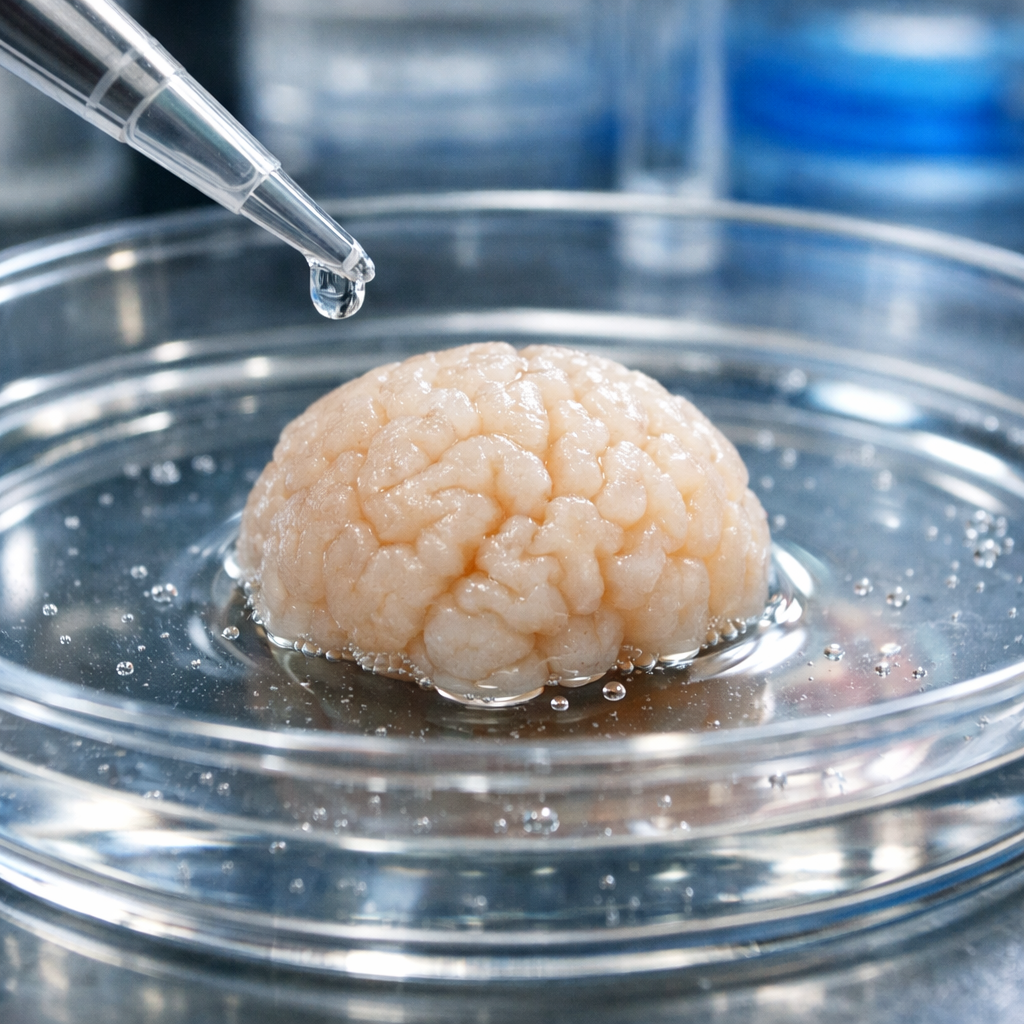
Johns Hopkins Researchers Grew Miniature Brain Structures From Patient Cells and Used Machine Learning to Identify Distinct Electrical Patterns Tied to Bipolar Disorder
Lab-grown brains sound like science fiction. But they are already detecting bipolar disorder. And the accuracy rate is remarkable.
Researchers at Johns Hopkins University created tiny brain-like structures called organoids by converting blood and skin cells from patients with bipolar disorder, schizophrenia, and healthy controls into stem cells. Those stem cells were grown into simplified versions of brain tissue capable of producing electrical activity.
The team, led by researcher Akhil Kathuria, placed the organoids on microchips fitted with multi-electrode arrays. A miniature EEG grid. Machine learning algorithms analyzed the electrical firing patterns of the neural networks that formed inside the organoids.
The results were striking: Organoids from bipolar patients produced distinct neural firing patterns that were easurably different from healthy controls. With baseline electrical activity alone: 83 percent accuracy. After applying subtle electrical stimulation to reveal additional neural responses, accuracy rose to 92 percent.
The results go beyond diagnosis. Kathuria’s team is working with neurosurgeons and psychiatrists at Johns Hopkins School of Medicine to test how various drug concentrations affect the organoids. The long-term vision is personalized medicine.
A patient with bipolar disorder could have an organoid grown from their own cells. Clinicians could test whether a specific medication works on that organoid before prescribing it.
That approach could help address one of the most frustrating aspects of bipolar treatment. Which is finding the right medication is mostly trial and error.
Months or years can go by while you cycle through drugs that may not work or cause intolerable side effects. An organoid-based screening tool would not replace clinical judgment. But it could narrow the field significantly.
The research also provides new insight into what’s physically different about the bipolar brain at the cellular level. The distinct electrical firing patterns suggest fundamental differences in how neurons form networks and communicate. Differences present even in tissue grown outside the body.
This technology is early stage. Sample sizes remain small. Growing organoids is time-consuming and expensive. Scaling it into a practical clinical tool will require years. But the fact that lab-grown tissue from a patient’s own cells can reliably identify bipolar disorder is a scientific milestone. It’s already attracting attention across the field.
A note from Liam Ronan: The trial-and-error approach to finding the right bipolar medication is one of the most exhausting parts of the condition for some people I have met. If a tiny piece of personal brain tissue grown in a lab could tell a doctor which drug would actually work before they spent months finding out the hard way, that could change everything.
Sources: Johns Hopkins Hub | ScienceDaily
See recent or related posts:
• Scientists Just Mapped the Genetic Blueprint of Mania
• Cognitive Impairments in Bipolar Disorder: Research Shows More Than Mood Swings
• Largest Genetic Study Ever Links 14 Psychiatric Conditions
• Parts of Brain Shrink After First Manic Episode in Young People
• High Verbal IQ in Childhood Linked to More Manic Traits in Adulthood
 Mania Insights
Leave a comment