
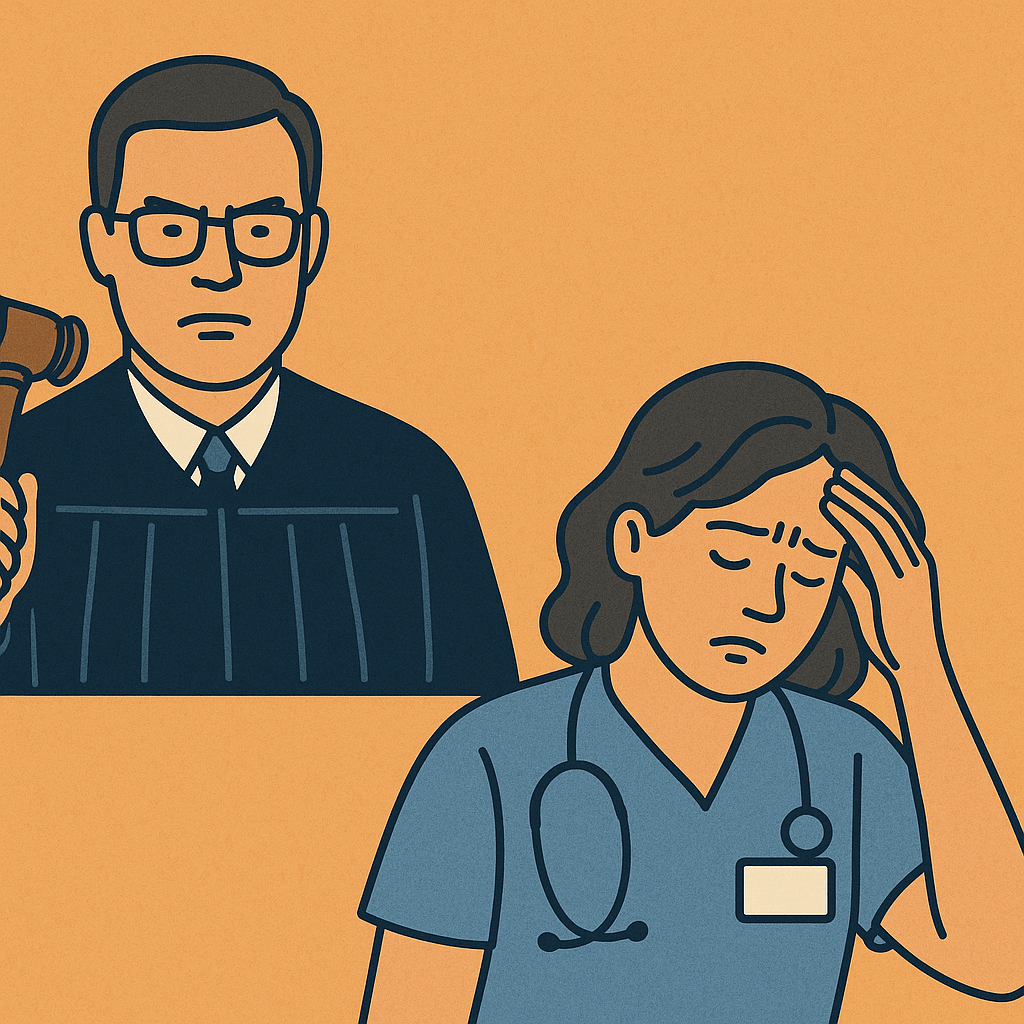
Judge says resignation was voluntary
– A federal judge in the Eastern District of New York granted summary judgment to New York Queens Medicine and Surgery, P.C., dismissing all disability claims brought by a former employee who resigned after a manic episode tied to bipolar disorder.
The plaintiff, whose identity remains anonymous, filed suit in 2022 alleging violations of the Americans with Disabilities Act, New York State Human Rights Law, and New York City Human Rights Law. Claims included:
- Failure to provide reasonable accommodations
- Disability-based discrimination
- Retaliation for requesting accommodations
- Constructive discharge, arguing conditions became intolerable because of her disability
Court records show the employee had previously received a temporary part-time schedule as an accommodation, supported by a psychiatrist’s note with an expiration date. When the employee sought an indefinite extension without new medical documentation, the employer denied an open-ended change but invited updated paperwork. During or shortly after a second manic episode involving erratic behavior, she resigned; the practice accepted the resignation without challenge.
In November 2025, the court ruled:
- The prior temporary part-time schedule satisfied the employer’s accommodation duty
- Employers have no obligation to grant indefinite accommodations or override a voluntary resignation, even during a mental-health episode
- The employee did not sufficiently engage in the process for further accommodations
- Voluntary resignation severed connection for discrimination, retaliation, or constructive discharge claims
The decision highlights ongoing challenges in ADA litigation involving mental health:
- Bipolar disorder affects roughly 2.8% of U.S. adults, with manic episodes sometimes causing workplace disruption
- Employers prevail in over 90% of ADA cases at summary judgment when resignation is deemed voluntary
- Successful claims typically require clear, timely accommodation requests and evidence of employer refusal to engage
Mental-health advocates say that with proper accommodations and open dialogue, most individuals with bipolar disorder can thrive professionally. Employment attorneys view the ruling as consistent with precedent: employers are entitled to accept resignations and are not required to provide unlimited flexibility.
Sources
VitalLaw / Wolters Kluwer https://www.vitallaw.com/news/discrimination-disability-e-d-n-y-medical-center-worker-who-resigned-after-second-manic-episode-cannot-advance-claims/eld01d097ca7a71ff4aa0aecd867059bddbbb
Bloomberg Law – Daily Labor Report – November 13, 2025 edition
U.S. District Court for the Eastern District of New York – Memorandum & Order Docket No. 1:22-cv-07000 (E.D.N.Y. 2025)
Recent articles
- Please Don’t Reply: Why I Sent Hundreds of Texts During My Manic Episode and Couldn’t Respond
- Why Manic Spirituality Feels More Real Than Reality
- Salt Cravings, Dirty Fingernails, and Cracked Skin: The Physical Signs of My Mania
- AI and Bipolar Disorder Mood Detection: How Machines Are Learning to Spot Mania Before You Can
- I Hid Things Everywhere, Even From Myself: The Compulsion Nobody Warned Me About

 Mania Insights
Leave a comment